Amsterdam has been another surprise of the trip. It truly is a beautiful city; a sort of Prague dropped on top of Venice, with Seattle and Boston influence (although, strictly speaking, the influence of course goes the other direction).
As is our habit we caught a bike tour first thing in the morning. Fortunately, the reigning champion of bike tours, Mike's Bikes, operates an Amsterdam branch. We made haste to join them and partook of the sheer joy that is biking in Amsterdam. The old city has just over 300,000 people and even more bikes. Many people don't own cars and many more haven't bought petrol in so long they don't know the price of it. The effect on the interior of the city is dramatic. Many roads are de-facto pedestrian routes that grudgingly part to allow cars through. Bike lanes abound and the canals make cars routes maddeningly circuitous while bikes can sail across old town in minutes. We soaked up, as always, a great deal of the history of the country, and learned a lot about how its past makes it the way it is today: The historically religiously open country that was rolled over by inquisitive Spanish Catholics, kicked them out and swung back to social liberalism, got rich on trade while the rest of the world squabbled over religous wars and imperialism, got rolled by fascists in the Second World war and responded with a defiant swell of tolerance and progressive social ideas once the Nazis were routed. Most of the famous (or infamous) social policies of the Netherlands amount to a constructive "piss-off" to the departing Nazi ideals. (Not just the well-known legalized cannabis and prostitution, but also women's suffarage, gay rights, and broad social support systems like a universal guarantee of housing.)
In our short stay here we had to brutally prioritize our sightseeing agenda, and after the bike tour the Anne Frank house was the natural next stop. It's kind of a pity that so much of European history is overshadowed by the relatively brief but recent events of the second world war. On the other hand, the wealth of records and the unimaginable horror at the heart of the war make it a very accessible, very compelling cautionary tale. The Anne Frank house and attached museum did their best to tap into this, though in a somewhat more storybook way (take the kids here when they're 10, wait till they're at least 13 for a concentration camp.). To me, the part that was the most truly interesting was an interactive exhibit set up near the exit of the museum. Called "Free2Choose" it showcased situations that called for a personal value judgement as to the limits of free speech, tolerance, liberties, and laws. It presented brief synopses of real-world events or controversies (like flag burning, head scarves for French school girls, holocaust denial, etc.) and asked the audience to vote using buttons placed around the room. It was quite interesting to see the groups reaction rendered in real time and compared to the average of all previous groups who had seen the presentation. The underlying theme of the exhibit was clearly emphasizing that tolerance and knowledge are the only true security against terror and tyranny; a good lesson for any age.
After paying our respects to Anne and her family we headed back to Zeedijk street, the main drag in the old part of town. Zeedijk is known for many things, including its ubiquitous roving bands of young anglo males, part of the rising tradition of holding stag party weekends in Amsterdam for British bachelors. It's also home to a confusion of Asian restaurants, Chinese, Japanse, Thai, the aromas of which mercifully cover the everpresent BO smell of pot smoke. We found a Thai restaurant (The Thai Bird) and had a pretty decent, if slightly overpriced meal. And no Thai Iced Tea, darn it!
No visit to Amsterdam would be complete without a stroll down Oudezjids Achterburgwal, a street that needs no introduction nor, in fact, any city-installed lighting. Paris has its Eiffel Tower, a monument to innovation and human ingenuity, Luzern has its wounded lion, a reminder of sacrifice and resistance to tyranny. And Amsterdam has Oudezjids Achterburgwal, the red light district, a testament to the spirit of live-and-let-live tolerance that has helped the Netherlands endure and thrive over the centuries despite the turmoil that engulfed the rest of Europe. Legalized since the 1980's, prostitution in Amsterdam is a strange blend of the profane and the mundane. Prostitues rent window space (and the accompanying rooms) for a set rate, and accept clients as they wish. Their "offices" have to meet hygiene standards, likewise themselves. The whole thing is legislated, regulated, inspected, and, naturally, taxed. Unlike the seedy image one pictures when thinking of the sterotypical red light district, Oudezjids Achterburgwal is surprisingly family-friendly. The window displays are, for the most part, nothing you wouldn't see in a Victoria's Secret store window (except the mannequins may wink suggestively at you) and the sidewalk traffic doesn't look too different from the average crowd emerging from a PG-13 movie. A large portion of the passers-by are, predictably, 25-40 something males, but women, teens, and grey-haired couples round out the mix. Life goes on, unfazed, on the streets on both sides of the district and the Dutch are happy to let tourist dollars come flowing in long after the novelty has worn off.
Leaving Oudezjids Achterburgwal bound for home we also decided to poke our heads into one of the many coffeeshops that abound in the area. They're pretty informal joints (no pun intended), most of them nothing more than a small, low room with comfortable chairs, dim lighting, and a bartender more likely to philosophically explain the paradox of a "victimless crime" than to separate drunken brawlers. More than a little self-conscious (I'll admit!) I strolled among the tables, just taking in the atmosphere (once again, no pun intended) and seeing what the culture was. It was, surprisingly, a little more akward going into the coffeehouse than it was walking down the street of the redlight district. Perhaps it's that going inside is an deliberate act, with less psychological deniabilty. I borrowed a menu from a serene girl in the corner and browsed the neatly laminated sheet which looked for all the world like the inventory of a drug bust. I figured since I was there, and feeling akward already, I might as well ask the girl at the bar to explain to me what I was looking at. The menu was divided up into different styles and strenghts of cannabis, and she explained why some patrons would prefer one versus another. Listening to her I began to see why the Dutch believe they have achieved civilization while much of the rest of the world are still locked into the self-imposed contortortions of moral and legal paradoxes.
Amsterdam has truly been one of the surprises of the trip. While the depth of history and culture alone are enough to keep you fascinated, the city is quaint and beautiful to boot. As much as we'd like to stay longer the end of our journey is rapidly approaching and we have, as they say, miles to go before we sleep. After touring the Van Gogh museum tomorrow morning we'll be making our way to Saint Malo tomorrow afternoon. Saint Malo (say it like the French; /San Mal-oh/) is a lovely ancient village on the rocky coast North coast of France, the historical home of fisherman and the secret base of the dashing French corsairs. The weather report for St. Malo is high of 68, low of 48, partly cloudy with showers--just like our Northern California coast. From St. Malo there we'll be daytripping to Mont St. Michel, that amazing monkery in an island castle you've no doubt seen in pictures. With only 6 days remaining of our trip we're both realizing that it has come to pass exactly as we knew it would: this trip has flown by. Much as both of us would gladly head back out if some eccentric millionaire offered us the means, at this point we're both warming to the idea of trading our worn backpacks for familiar beds and seeing old friends and family again.
Sunday, July 29, 2007


Saturday, July 28, 2007
Yeah, it smells just like you might expect
We've arrived in Amsterdam! Which is in the Netherlands. Or is it Noord Holland? And they speak Dutch. Yeah, I'm still haven't figured it all out yet, either. Of course, that's what this whole excursion is for, anyway.
This third night train, from Prague, was by far the most interesting yet, the telling of which I will leave to Patrick to fill in since it's really his story.
More commentary on the city and the production that we're going to when we get back this evening.
This third night train, from Prague, was by far the most interesting yet, the telling of which I will leave to Patrick to fill in since it's really his story.
More commentary on the city and the production that we're going to when we get back this evening.
Thursday, July 26, 2007
Go West, young man!
Yesterday's first westward train journey marks the official beginning of our return trip!
Our accomadations on this trip weren't quite as idyllic as our previous night train. Though the company was just as good, there was quite a bit more of it; our six bed couchette was packed to the gills with two girls from Yorkshire, us, and a couple from DC traveling to Poland to introduce him to her parents. Patrick managed to find us and a fellow traveller sub sandwiches by way of a late dinner, but the compartment crowded with sleepers and the tiny hallway gave us no place to sit and enjoy them. Eventually the hallway traffic thinned out and we decided just to plunk down in the narrow hall, hoping it wasn't verboten. We had just begun our furtive supper when the conductor poked his head from his compartment and said something in Czech. Summoning my hard won international communication skills I raised my sandwich and gestured to the seated group, "Ist OK?" He nodded dismissively then repeated his question; it ended in "...bier?" Wait...did he say beer? To emphasive, he pantomimed the approximate dimensions of a generous bottle and said "Czech bier, ein Euro." We wasted no time in rewarding our man's entrepreneurial spirit and settled down again to enjoy what was shaping up to be an enjoyable evening. The night was, as always, punctuated by jarring station stops and passport controls, but we managed some sleep and arrived in Prague to sunrise and, once again, few tourists.
Now that we've been here for a day, I can confirm: Prague is as they say. Miles and miles of narrow, cobbled streets wind through the old town. No mere exhibit or token, like many of the vielles villes in European capitals, Prague's old town is large enough to pass for a city in its own right. Even after having seen so many quaint old streets thus far we had to marvel at the sheer scale. It just keeps going! Here there isn't the underlying worry of taking a wrong turn and stumbling out of Disneyland into mundane modernity waiting just beyond.
As is our habit we hooked up with a bike tour to orient ourselves. The bikes they provided were no granny-style fat tire cruisers. They were well maintained middle of the line mountain bikes with thick treads and better shocks. We found out soon enough why: the cobblestones nearly rattled our teeth loose. Among the notable sites on the tour, the tallest structure in Pague particularly amused me. This TV tower, built in the late 80's as a last gasp of Eastern European communism, only ever carried 3 stations: It was built primarly to block Western transmissions. After a helpful but somewhat uninspiring tour we crossed joined the crush of tourists and followed Karlova Street to the famous Charles Bridge. By the time we arrived at the gates of Prague Castle the combined effects of a short night, long day, hot sun, and surfeit of tourists combined to leave us uninterested in further culture for the day. Instead we found a grassy patch on the hill and napped for a few hours, finally waking to 6:00 tolling from the nearby church, which we took for our dinner bell.
Edit: Patrick notes that we are now carrying 7 currencies. They are, in order
and the bonus round, the piece-de-la-resistance...
Edit: I just viewed the blog using Internet Explorer and I note that the pictures seem to load strangely or not at all. Probably the legacy of my amateur html skills. If you're using IE (and oh God why?) you might have better luck with something else.
Our accomadations on this trip weren't quite as idyllic as our previous night train. Though the company was just as good, there was quite a bit more of it; our six bed couchette was packed to the gills with two girls from Yorkshire, us, and a couple from DC traveling to Poland to introduce him to her parents. Patrick managed to find us and a fellow traveller sub sandwiches by way of a late dinner, but the compartment crowded with sleepers and the tiny hallway gave us no place to sit and enjoy them. Eventually the hallway traffic thinned out and we decided just to plunk down in the narrow hall, hoping it wasn't verboten. We had just begun our furtive supper when the conductor poked his head from his compartment and said something in Czech. Summoning my hard won international communication skills I raised my sandwich and gestured to the seated group, "Ist OK?" He nodded dismissively then repeated his question; it ended in "...bier?" Wait...did he say beer? To emphasive, he pantomimed the approximate dimensions of a generous bottle and said "Czech bier, ein Euro." We wasted no time in rewarding our man's entrepreneurial spirit and settled down again to enjoy what was shaping up to be an enjoyable evening. The night was, as always, punctuated by jarring station stops and passport controls, but we managed some sleep and arrived in Prague to sunrise and, once again, few tourists.
Now that we've been here for a day, I can confirm: Prague is as they say. Miles and miles of narrow, cobbled streets wind through the old town. No mere exhibit or token, like many of the vielles villes in European capitals, Prague's old town is large enough to pass for a city in its own right. Even after having seen so many quaint old streets thus far we had to marvel at the sheer scale. It just keeps going! Here there isn't the underlying worry of taking a wrong turn and stumbling out of Disneyland into mundane modernity waiting just beyond.
As is our habit we hooked up with a bike tour to orient ourselves. The bikes they provided were no granny-style fat tire cruisers. They were well maintained middle of the line mountain bikes with thick treads and better shocks. We found out soon enough why: the cobblestones nearly rattled our teeth loose. Among the notable sites on the tour, the tallest structure in Pague particularly amused me. This TV tower, built in the late 80's as a last gasp of Eastern European communism, only ever carried 3 stations: It was built primarly to block Western transmissions. After a helpful but somewhat uninspiring tour we crossed joined the crush of tourists and followed Karlova Street to the famous Charles Bridge. By the time we arrived at the gates of Prague Castle the combined effects of a short night, long day, hot sun, and surfeit of tourists combined to leave us uninterested in further culture for the day. Instead we found a grassy patch on the hill and napped for a few hours, finally waking to 6:00 tolling from the nearby church, which we took for our dinner bell.
Edit: Patrick notes that we are now carrying 7 currencies. They are, in order
- US Dollars
- British Pounds
- European Union Euros
- Swiss Suissefrancs
- Hungarian Forints
- Polish Zloty (/zwah-tee/)
- Czech Koruna
and the bonus round, the piece-de-la-resistance...
- Austrian Schillings (discontinued in 1993, found in the gutter!)
Edit: I just viewed the blog using Internet Explorer and I note that the pictures seem to load strangely or not at all. Probably the legacy of my amateur html skills. If you're using IE (and oh God why?) you might have better luck with something else.
Monday, July 23, 2007
If the left don't get ya then the right one will...
Poor Poland. It's whole history it's been battered about, perpetually caught between expansionist and warlike neighbors, most notably Prussia/Germany on the left and Russia on the right. If it weren't for the language (and what a language!) and the unshakable Catholicism Poland would be undefinable as a country, so many times has it been annexed, taken over, carved up, and generally abused by its neighbors. Fortunately, this willingness to ride out the bad times with stoic dignity has paid dividends for Poland in at least one way: architectural heritage.
Many of the other major cities of Europe display a subtle charade to tourists, which our Munich guide Adam referred to as the "Bombed Style" of architecture. In short, many MANY of these old buildings in the center of town simply *aren't* old. They're cleverly crafted copies done in the style of the demolished original. So great was the destruction in some places that cities like Frankfurt and Munich held town votes to decide how to go about rebuilding the city; bulldoze and start over or rebuild it like it was (We have the technology...). In Frankfurt they decided that the Etch-a-Sketch had been shaken beyond saving; they literally redrew the city map and filled in with whole new buildings. Munich, by a close vote, went the other way, opting to preserve their historic feel and rebuild the city to look like it did ante-bellum (before it got it's bell rung). This gave birth, somewhat unceremoniously, to the "Neo-" style of architecture. You had a Gothic city hall that got asploded? The replacement is the "Neo-Gothic" Rathaus. Lost your government building dating back to the Renaissance? How about a good-as-old "Neo-Renaissance" copy on the same spot? (Plus a nice little modernist touch: Large glass and steel sides on the office, facing the public park so that the citizens can look in and watch their government at work. Methinks the architect was making a statement...)
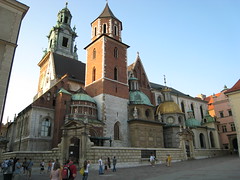
Krakow, by contrast, doesn't have this. In fact, compared to the others, Krakow is at times a bewildering architectural kaleidescope. With no B-17s to simplify matters the city has retained its natural strata of styles from the different fits and spurts of building throughout its history. Nowhere is this more apparent than the almost comically embellished Wawel Cathedral. If you think it looks like a half-dozen or more rulers all tacked on their pet project using the current fashion in architecture, then you're right. My friend Rick tells me that the tote board here reflects 14th-century Gothic, 12th-century Romanesque, 17th-century Baroque, 16th-century Renaissance, and 18th- and 19th-century Neoclassical (In the sense of based-on-classical, not based-on-a-bombed-original-that-was-based-on-classical).
Prague made its tourist reputation on its similar fortune of not having been rubbled during the war, and I hear that, as much as Krakow touts itself as "the next Prague", the real thing is still king. All in all, Krakow has had its charms but for me it will remain firmly in Budapest's shadow. I'm ready for the train; old Praha has promised a lot and I really want to see it deliver.
Bonus feature: Scavenger Hunt!
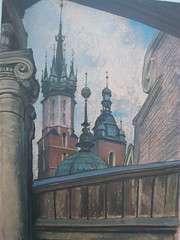
We all want to be Sherlock Holmes, Indiana Jones, and Gil Grissom, to look at the elements everyone else sees and put them together in a new way. We like the challenge, and we like the hunt for its own sake. Walking along an outdoor display of reproductions from Krakow artist Stanislaw Wyspianski we noticed one that was clearly a scene painted from within the city itself. If you can recognize one church anywhere in the world by its towers alone, it's gonna be St. Mary's and its famous mismatched pair. Well, we got to thinking, in a very grassy-knoll, Raiders-of-the-Lost-Ark kind of way, that it should be a simple matter to figure out where this guy's perch was.
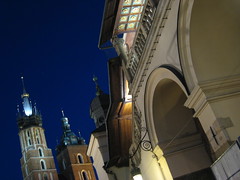
Patrick took a picture of it for reference and, after Chinese for dinner (no sushi yet, Patrick insists, we're still 400 miles from the ocean) we headed back into town to get to the bottom of this. Naturally we stuck out like sore thumbs wandering around the main square alternately looking from the cathedral to our camera to the surrounding buildings. With some good inferences and a sharp eye we spotted the dome in the mid-foreground of the photo. A few moments later it all fell into place: The Princess-Leia ionic columns, the bronze ball, the low wall...He had to have been atop the Cloth Hall! Here, see for yourself!
Many of the other major cities of Europe display a subtle charade to tourists, which our Munich guide Adam referred to as the "Bombed Style" of architecture. In short, many MANY of these old buildings in the center of town simply *aren't* old. They're cleverly crafted copies done in the style of the demolished original. So great was the destruction in some places that cities like Frankfurt and Munich held town votes to decide how to go about rebuilding the city; bulldoze and start over or rebuild it like it was (We have the technology...). In Frankfurt they decided that the Etch-a-Sketch had been shaken beyond saving; they literally redrew the city map and filled in with whole new buildings. Munich, by a close vote, went the other way, opting to preserve their historic feel and rebuild the city to look like it did ante-bellum (before it got it's bell rung). This gave birth, somewhat unceremoniously, to the "Neo-" style of architecture. You had a Gothic city hall that got asploded? The replacement is the "Neo-Gothic" Rathaus. Lost your government building dating back to the Renaissance? How about a good-as-old "Neo-Renaissance" copy on the same spot? (Plus a nice little modernist touch: Large glass and steel sides on the office, facing the public park so that the citizens can look in and watch their government at work. Methinks the architect was making a statement...)
Prague made its tourist reputation on its similar fortune of not having been rubbled during the war, and I hear that, as much as Krakow touts itself as "the next Prague", the real thing is still king. All in all, Krakow has had its charms but for me it will remain firmly in Budapest's shadow. I'm ready for the train; old Praha has promised a lot and I really want to see it deliver.
Bonus feature: Scavenger Hunt!
Sunday, July 22, 2007
Can't go wrong with Mama
 As we travel we make a conscious effort to stay close to the ground; hostels instead of hotels, small locally-owned eateries off the beaten path, and word of mouth recommendations as much as possible. This tends to give us a more colorful, cultural and local experience. The hostel guests and proprietors are more talkative and interesting and the guy behind the counter at the restaurant seems a little less burned out on tourists. This general policy however, has led us to an even more specific traveler's axiom: you can't go wrong with Mama.
In Corniglia, you remember that our under-the-table pensione (/pen-see-ohn-ay/) was secured by the Godfather-channeling "Mama" Angela. In Budapest, we found our authentic local Hungarian at Zsoka Mama's, a 6 table restaurant wedged into a small storefront a couple blocks off the main drag. Finally, tonight and last night we stuffed ourselves to bursting on rich, earthy polish food at an eatery that feels like you've walked into a Polish granny's living room -- for about $5 (US) per person. The place is "Kuchnia U Babci Maliny", and if you guessed that the translation includes "Grandma's" you win the prize.
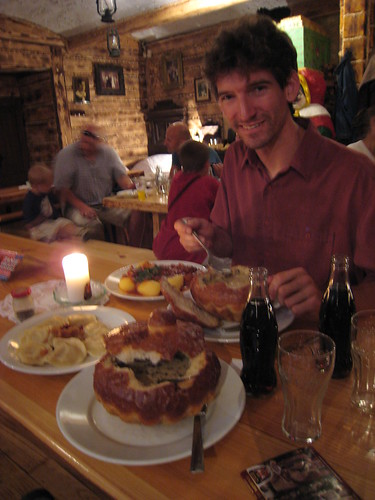
The prototypical "Mama's" isn't ritzy or flashy; in fact, it's usually humble and often downright hard to find. Mama isn't trying to impress you, and you certainly can't impress mama; she's been at this since you were in diapers. Mama hasn't changed with the times or the tourists either; she's still using her mama's recipe.
Mama has seen us through so far and you can bet your bottom zloty that we'll keep coming back to her, wherever we find her.
Saturday, July 21, 2007
The pictures, they MOVE!
Yes indeed, we have another special treat for you. Grab yourself a beverage and enjoy the third production of Rambling Rovers Motion Picture Studios, "Tunnel Vision"
Also, (as Krystal so perceptively pointed out) we have new photos up on the flickr site, from the end of Budapest through today. In lieu of a blog post today I have gone through and added my two zlotkys worth to the captions.
Also, (as Krystal so perceptively pointed out) we have new photos up on the flickr site, from the end of Budapest through today. In lieu of a blog post today I have gone through and added my two zlotkys worth to the captions.
Whatchu gonna do when they come for you?
We caught our first night train last night, leaving Budapest behind just as the clouds began to gather. As a send-off the city even managed to muster 20 minutes of sprinkling rain, almost as if in apology for the record-breaking heat wave.
We settled into our couchette and awaited the bad news...who were we going to have for roommates? Afterall, there are 6 bunks in the 8x8x8 2nd class couchettes and they don't see anything inhumane about allowing snorers and stinkers and amorous couples onto these trains. Much to our relief, we instead got Miwa, come all the way from Japan on a solitary jaunt around eastern Europe. She was doing Croatia, Slovenia, Bosnia, Herzegovina, as well as Hungary and Poland. As I mentioned in the last post, 3 weeks ago I really wouldn't have considered those to be tourist destinations; I've heard too much about them in the news and not enough in the travel guides. Well, now I know better. I don't speak Croatian any better than I speak Hungarian, but you can't get any worse than totally illiterate, and yet I managed fine in Hungary. It's all the same, really, once you know how to play the game. (This doesn't mean I'm planning a trip to, say, Iraq anytime soon. I prefer to see AK-47s on TV.)
The night train looks to be as good an idea as the 3 day mercy rule. Traveling at night turns a 3 night stay into 4 useful days instead of 2 and 2 halves. Only problem are the border crossings and the ensuing passport checks. Stamp out at the Hungarian border. Then for entering Slovenia. Then for leaving Slovenia. Then for entering Poland. I just don't think I'll ever get used to being rousted out of a sound sleep by stern looking officers armed with guns and scowls, speaking brusquely in a language I utterly don't comprehend. I've watched enough COPS to know that talking to police while barechested and bleary eyed requires deliberate dignity and slow, obvious movements. While I could do without the hourly passport parade at least I now know how to thank them for their troubles. In Hungary kursunum did the job, and for the Polish cop my mind was somehow able to dredge up dziekuje in a close enough approximation that he responded with what I can only assume to be the Polish equivalent of "you're welcome."
We arrived in Krakow at 5:30am, probably our earliest morning so far. We hooked through the old town on the way to our hostel and entered through the Florian Gate, the best preserved remains of the old city wall. We made our way to the main market square just as the sun rose over Saint Mary's cathedral, enjoying the empty plaza populated by many pigeons but few tourists. We even managed to arrive right on the hour to hear the bugler play his hourly call from the watchtower attached to Saint Mary's. The bugler is always a fireman, part of the city's best loved tradition that evokes the legend of a town watchman in the tower that spotted a Tartar army approaching and sounded the alarm. Before he could finish his tune an arrow pierced his throat, cutting him short. To this day the call stops short of the end of the song.
We're now at the Deco Hostel, having managed a much delayed and much needed shower after the sauna like heat of the city and the cramped train car. We're going to head back out on the town, probably catch a bike tour by way of orientation, then, hopefully, return to the hostel later tonight and upload some photos which we kinda owe you all for all the wordy posts. Na zdrowie and czesc,*!
(*Cheers and goodbye, naturally!)
We settled into our couchette and awaited the bad news...who were we going to have for roommates? Afterall, there are 6 bunks in the 8x8x8 2nd class couchettes and they don't see anything inhumane about allowing snorers and stinkers and amorous couples onto these trains. Much to our relief, we instead got Miwa, come all the way from Japan on a solitary jaunt around eastern Europe. She was doing Croatia, Slovenia, Bosnia, Herzegovina, as well as Hungary and Poland. As I mentioned in the last post, 3 weeks ago I really wouldn't have considered those to be tourist destinations; I've heard too much about them in the news and not enough in the travel guides. Well, now I know better. I don't speak Croatian any better than I speak Hungarian, but you can't get any worse than totally illiterate, and yet I managed fine in Hungary. It's all the same, really, once you know how to play the game. (This doesn't mean I'm planning a trip to, say, Iraq anytime soon. I prefer to see AK-47s on TV.)
The night train looks to be as good an idea as the 3 day mercy rule. Traveling at night turns a 3 night stay into 4 useful days instead of 2 and 2 halves. Only problem are the border crossings and the ensuing passport checks. Stamp out at the Hungarian border. Then for entering Slovenia. Then for leaving Slovenia. Then for entering Poland. I just don't think I'll ever get used to being rousted out of a sound sleep by stern looking officers armed with guns and scowls, speaking brusquely in a language I utterly don't comprehend. I've watched enough COPS to know that talking to police while barechested and bleary eyed requires deliberate dignity and slow, obvious movements. While I could do without the hourly passport parade at least I now know how to thank them for their troubles. In Hungary kursunum did the job, and for the Polish cop my mind was somehow able to dredge up dziekuje in a close enough approximation that he responded with what I can only assume to be the Polish equivalent of "you're welcome."
We arrived in Krakow at 5:30am, probably our earliest morning so far. We hooked through the old town on the way to our hostel and entered through the Florian Gate, the best preserved remains of the old city wall. We made our way to the main market square just as the sun rose over Saint Mary's cathedral, enjoying the empty plaza populated by many pigeons but few tourists. We even managed to arrive right on the hour to hear the bugler play his hourly call from the watchtower attached to Saint Mary's. The bugler is always a fireman, part of the city's best loved tradition that evokes the legend of a town watchman in the tower that spotted a Tartar army approaching and sounded the alarm. Before he could finish his tune an arrow pierced his throat, cutting him short. To this day the call stops short of the end of the song.
We're now at the Deco Hostel, having managed a much delayed and much needed shower after the sauna like heat of the city and the cramped train car. We're going to head back out on the town, probably catch a bike tour by way of orientation, then, hopefully, return to the hostel later tonight and upload some photos which we kinda owe you all for all the wordy posts. Na zdrowie and czesc,*!
(*Cheers and goodbye, naturally!)
Subscribe to:
Posts (Atom)